Somerset Medical Center
The Good Nurse: A True Story of Medicine, Madness, and MurderSomerset Medical Center is both the workplace where Charles Cullen became a trusted night nurse and the setting of the investigation into a succession of unexplained patient poisonings. Its Critical Care Unit offered him repeated access to vulnerable patients and medication systems; after suspicious deaths emerged, the hospital’s decision to investigate internally before reporting the incidents to authorities became a consequential part of the story. The site’s significance lies in that convergence: familiar routines of bedside care and drug administration became difficult to distinguish from opportunities for concealed harm, while the institution struggled to turn troubling clinical facts into action.
Setting and Cullen’s arrival
In September 2002, Somerset Medical Center offered Cullen a full-time position caring for some of its most vulnerable patients in the Critical Care Unit. The hiring process included a favorable account from a former supervisor at Warren Hospital, who praised Cullen’s work ethic, conscientiousness, and intelligence. Saint Luke’s Human Resources verified his dates of employment and former position. Those assurances preceded his rapid acceptance on the unit, where patients required intensive monitoring and nurses worked overnight shifts.
Cullen became popular with colleagues through an efficiency that made the unit’s handoffs easier. He asked few questions, moved quickly down the hall with a portable Cerner PowerChart, and often finished tasks before other nurses. Colleagues returning from initial patient checks could find him at the Pyxis machine helping lay out IV bags; later, he might be helping at a code. These visible acts of assistance helped establish him as a useful, dependable presence within the night crew.
The unit’s work was organized around changing combinations of nurses, since each night shift had its own schedule and composite staff. Cullen’s quiet manner and readiness to help stood out to Amy Loughren, a fellow night nurse who was outspoken and direct. During long shifts, they developed a friendship through exchanges about hospital bureaucracy and stories Cullen told about depression, bad luck, and feeling victimized. In retrospect, the routine that made him seem unobtrusive also placed him in close proximity to patients, medication, and the movement of drugs through the unit.
The unit’s routines and warning signs
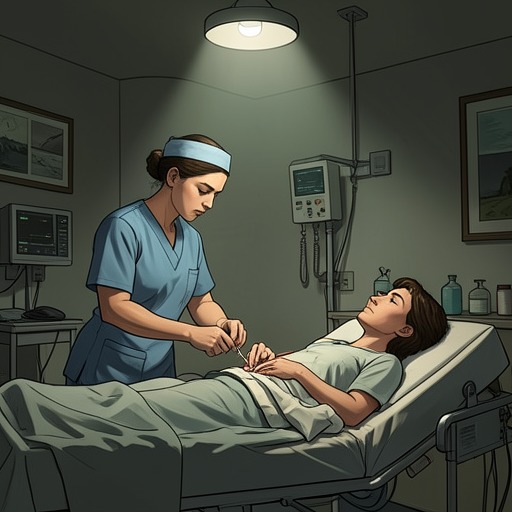
The hospital’s one-on-one care model meant that patients occupied private rooms. Cullen could use a legitimate nursing task—injecting into a piggyback port on an IV line—to conceal a direct injection of clear Digoxin. If interrupted, the action could appear to be ordinary line flushing. The privacy that supported individualized care therefore also limited casual observation. At night, when the gift shop and public bathrooms were closed and visitors and administrators were absent, the hospital took on a quieter, more restricted character that Cullen preferred.
Medication access depended on both the Pyxis system and the routines surrounding the medical supply room. Pharmacy runners delivered medicines for the night shift, and staff entered the storage room by code. After colleagues became uneasy, Gerry Kimble, Candy Wahlmark, and Kim Wolfe took turns watching the room while continuing to care for patients. Kim saw one unfamiliar person enter and restock while keeping the door wedged open; later, she watched the pharmacy worker enter in much the same way. The episode did not identify a culprit, but it showed how ordinary traffic through a coded room could frustrate attempts to determine who had access and what their actions meant.
Insulin also became a point of friction on the unit. Amy was asked to sign an insulin adjustment form that required nurses to estimate how much remained in a vial. She considered the estimate unreliable and objected to signing for it. Her manager did not explain what had prompted the changed procedure, though Amy suspected that something had happened on her unit, possibly involving a patient. The new accountability measure made the danger of insulin more visible while withholding the information that might have explained why the procedure had changed.
Patient incidents and the internal inquiry
The sequence of cases later presented to investigators began with incidents recorded over five months. Somerset Medical Center reported patients Joseph Lehman on May 28, Frances Kane on June 4, Jin Kyung Han on June 16, Reverend Florian Gall on June 28, and Francis Agoada on August 27; McKinley Crews, who died four days before the hospital contacted the prosecutor, was identified as a sixth incident. The hospital described the cases as unexplained patient incidents in the Critical Care Unit. Their accumulation changed the meaning of individual abnormal lab results: what might initially have appeared isolated now formed a pattern requiring explanation.
The evidence around Han and Gall sharpened that concern. Han had arrived with Hodgkin’s lymphoma and heart disease and had received small, therapeutic doses of Digoxin. After reviewing her electrocardiogram, her cardiologist discontinued the drug because it might worsen her new arrhythmias. On June 14, Cullen arrived early, reviewed patient charts, and selected Han, although she was not his patient. He injected into her IV a Digoxin dose eight times larger than any she had previously received, discarded the needle in a sharps bin, and left. The dose was expected to take effect after his shift; when Cullen returned early on June 16 to check, Han was still in the hospital.
Reverend Florian Gall entered the unit critically ill with a severe infection, failing kidneys, and lungs that could no longer supply sufficient oxygen. He was placed on a ventilator and required dialysis. On June 28, he suffered cardiac arrest at about 9:32 a.m.; resuscitation failed, and his death was recorded at 10:10. His Digoxin level was far above the expected range. The hospital called him Patient 4, acknowledged that his death was not natural, and recognized that he was not the first such case.
After Gall’s death, pharmacy staff were asked to examine Pyxis access around the dates of the Digoxin deaths and contact New Jersey Poison Control Center to help calculate what doses could account for the levels in Gall’s blood. A meeting convened after nurse Marty Kelly asked to see Risk Manager Mary Lund. Participants included medical, pharmacy, laboratory, critical-care, and risk-management staff. Their review focused especially on Han and Gall and on canceled medication orders. Pharmacy’s question to Poison Control was initially framed as a request for dosage calculations; Poison Control director Steven Marcus concluded that the data were not ambiguous and warned that patients might continue to suffer while the hospital delayed acknowledging what they indicated.
Somerset Medical Center nevertheless maintained that it would complete a thorough internal investigation before notifying either the state health department or police. Marcus told administrators that suspected incidents had to be reported to the state within twenty-four hours and that the hospital was already out of compliance. The hospital did not report them at that stage. A state investigator, Edward Harbet, visited on July 11 and 14, reviewed records for reported patients and the hospital’s internal summary, and interviewed administrators. He found no specific explanation for the abnormal lab values; he was satisfied with the attention the hospital was paying and did not advise an additional external report. The review therefore failed to identify a cause while also failing to prompt a further report at that point.
Investigation, records, and divided trust
When the Somerset County Prosecutor’s Office was eventually brought in, its investigators faced a substantial information problem. The hospital’s five-month inquiry had produced only four pieces of paper and no clear answers. Investigators understood that drugs had poisoned patients, but they lacked Pyxis records, interviews, and physical evidence. The gap between clinical suspicion and an investigative trail was especially consequential in a hospital, where the relevant actions could resemble routine care and medication records were essential to reconstructing access.
The later Pyxis reports offered time-stamped lines showing the unit, type of drug ordered, and patient to whom it was billed. Read alongside Cerner records, the reports became the largest body of evidence connecting Cullen to drugs associated with Gall’s death. They established that Cullen could have obtained medication, but possibility was not proof that he had administered it. The Gall toxicology report found Digoxin in the vitreous fluid, spleen, heart, and kidney, and excluded approximately ninety-six other drugs tested. The findings allowed the medical examiner to classify the cause as Digoxin toxicity and the manner as homicide, identifying both a murder victim and a likely weapon without, by themselves, establishing who had delivered it.
Amy’s knowledge of the unit helped investigators interpret records that would otherwise have remained technical entries. When shown Cullen’s Pyxis activity, she recognized its significance, even as she struggled to reconcile the paper with the friend she had defended against what she considered unfair accusations. She also noticed that the Digoxin orders did not align with the Digoxin deaths, while Cullen’s Tylenol orders did align with the cases in a pattern she found bizarre. The records thus supplied both a lead and a contradiction: medication access could be traced, but the ordered drug did not always neatly match the suspected poisoning.
The investigation also altered Amy’s standing at Somerset Medical Center. Colleagues knew she was Cullen’s friend and remembered her objections to signing for insulin; some avoided her, and those close to her worried about her. She feared for herself as well. Cooperating meant risking her job, deceiving Cullen and her employer, and trusting detectives she did not yet know well. She remained a nurse, but only the investigators knew the extent of her role. After shifts she brought paperwork and shared coffee with Tim Braun and Danny Baldwin, whose presence made her feel less isolated. Her divided loyalties show how the hospital was not merely a crime scene: it was also the workplace whose professional relationships and hierarchies shaped who could speak, what they could know, and what speaking might cost.
Reporting, aftermath, and significance
The reporting history did not move in a straight line from discovery to action. The New Jersey Department of Health’s review preceded its later contact with the Attorney General’s office. In a September 26 communication, staff member Amie Thornton noted that the hospital appeared to suspect foul play and had retained private investigators and attorneys. Seven days later, Somerset Medical Center contacted the Somerset County Prosecutor’s Office. The sequence underscores the difference between recognizing an abnormality, deciding that it may be criminal, and placing the matter before an agency able to investigate it as a crime.
The hospital later stated that it had fully cooperated with interested parties and agencies during the investigation and that it was directing its resources toward providing high-quality community care. It continued to be described as one of New Jersey’s leading health-care centers. That public account sits beside the documented delay in reporting and the investigators’ early difficulty obtaining records and answers. The contrast does not erase the hospital’s clinical function; it makes the institution’s dual role central. Somerset Medical Center was where patients received intensive care, where Cullen’s helpfulness became part of the night-shift routine, and where abnormal cases accumulated before their significance was fully acknowledged.
As a narrative setting, Somerset Medical Center joins the intimacy of bedside nursing to the scale of institutional procedure. A private room, an IV port, a coded supply room, a chart, and a medication report each appear ordinary in isolation. Their meanings shift as the cases accumulate: the same routines that supported care could conceal an injection, while the same records that might expose a pattern were initially unavailable to investigators. The hospital’s importance therefore extends beyond being the location of the poisonings. Its response reveals how a suspected pattern can remain suspended among clinical judgment, internal review, professional loyalties, and external oversight before it becomes an actionable investigation.